A Pillar of the MEG Curriculum
Raising AI-ready, AI-wise young leaders who use these tools to think harder, not less — and who never mistake confidence for truth.
Why It Matters
Artificial intelligence is already part of how young people do homework, search for answers, and communicate. Our job isn't to pretend that away — it's to make sure our students understand what AI actually is, where its limits are, and how to use it as a tool for their own growth instead of a shortcut around it.
This program is grounded in the same character-first philosophy that runs through everything we teach: confidence, judgment, and self-respect apply just as much to a screen as they do to a dinner table.
Our approach is informed by research-based frameworks such as the MIT Media Lab's AI + Ethics and Primary School AI Education curricula, adapted into MEG's own hands-on, character-centered lessons.
The Three Pillars of AI Training
Inside The Classroom
Here's how a typical Youth AI Training session unfolds — built to build intuition first, then hands-on skill, then judgment.
Before we ever say the word "AI," students play a quick guessing game — finishing a sentence like "The dog ran across the ___." Then we ask: how did you know that? The answer — "it made sense, that's what normally happens" — is the exact mental model for how AI predicts text. Kids discover the concept themselves before we ever name it.
A plain-language mental model, no jargon and no mystique: AI isn't alive and it isn't thinking the way people think. It's a very good pattern-predictor, trained on huge amounts of text. That means it can be incredibly helpful — and it also means it can sound completely confident while still being wrong.
Students build a real AI tutor prompt together, live, using a real homework subject. Instead of asking AI to hand over answers, they set it up to ask them questions — so it works like a coach, not a cheat sheet. They watch, in real time, the AI asking questions back instead of giving answers away.
We close on the character lesson underneath everything: sounding confident doesn't mean being right — for AI, or for people. Students learn to check another source, ask a follow-up question, or ask a trusted adult, rather than accepting something just because it sounded sure of itself.
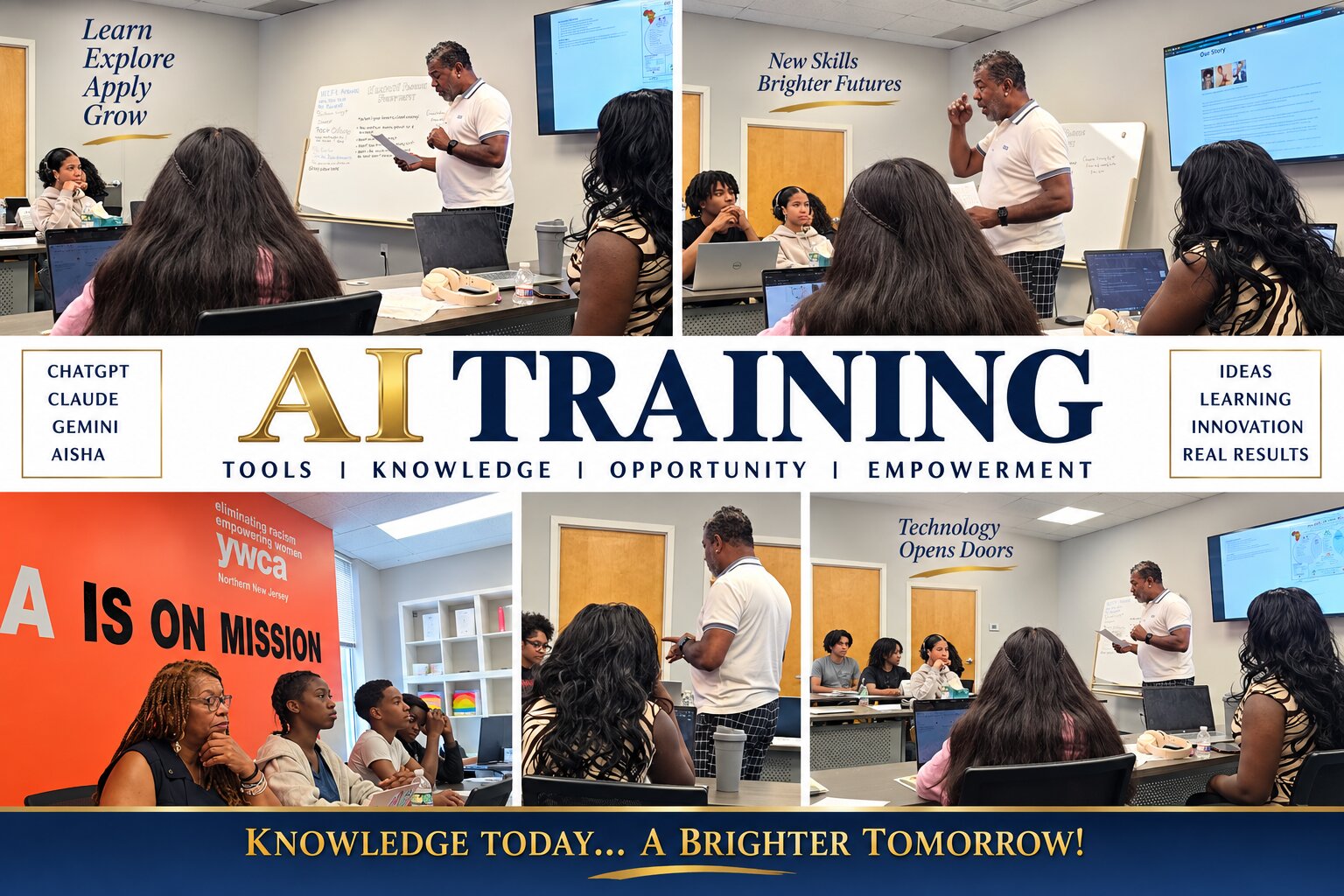
Partnership In Practice
Our Youth AI Training curriculum has been delivered directly inside partner sites, including a paid workshop session for YWCA Northern New Jersey — "Eliminating Racism, Empowering Women." Students worked hands-on with real AI tools while learning the same character-first judgment we teach at every MEG session: think it through, don't just trust the confident-sounding answer.
This is the model we bring to schools, youth organizations, and community partners: a ready-to-run session, delivered by MEG, grounded in a curriculum your students will actually use.
Book a Session For Your OrganizationWhat Students Take Home
Every student leaves with a prompt template that turns any AI tool into a Socratic homework helper — one that asks questions instead of giving answers away.
You're my homework buddy for [SUBJECT]! I'm in [GRADE].

Here's how to help me:
1. Don't just give me the answer — ask me questions so I can
   find it myself!
2. If I get it wrong, don't say "wrong" right away. Ask me
   "why do you think that?" first.
3. Use fun examples, like games, animals, or stuff kids like.
4. Use short, easy words. No big confusing sentences.
5. Be encouraging! Like a coach, not a teacher with a red pen.
6. At the end, give me 2-3 quick questions to check what
   I learned.

What I'm working on today: [TOPIC]